Gross Burn is the total cash a company spends on operations each month, including salaries, rent, overhead, interest, and taxes. Unlike Net Burn, Gross Burn does not account for revenue — it reflects the full cost of keeping the business running.
ƒ COGS + Salaries and Overhead + Depreciation and Amortization + Other Operating Expenses + Interest and Taxes
A SaaS startup spends $180,000 per month: $60,000 in salaries, $30,000 in COGS, $20,000 in marketing, $15,000 in rent, $10,000 in contractor fees, $8,000 in depreciation, and $7,000 in taxes and interest.
Gross Burn = $60,000 + $30,000 + $20,000 + $15,000 + $10,000 + $8,000 + $7,000 = $180,000 per month
If the company holds $1.8M in cash, it has approximately 10 months of runway at the current burn rate — assuming no revenue offsets or changes in spending.
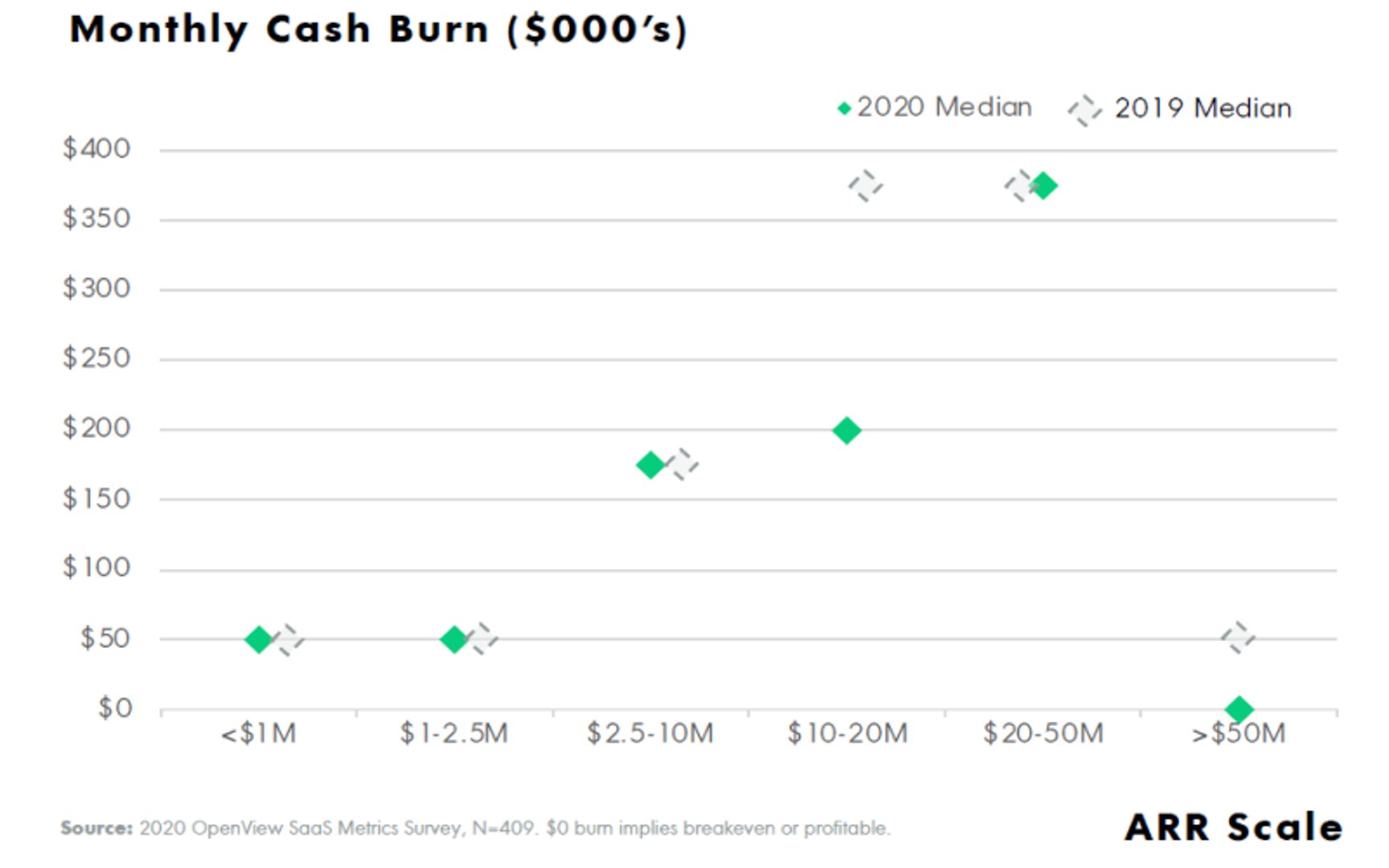
The median monthly cash burn is $175K for companies with $2.5M–$10M ARR. Note: source and publication date for this figure are unverified — flag for review before republishing.
Use a summary chart to visualize your Gross Burn data and compare it to a previous time period.
Gross Burn vs. Net Burn
Gross Burn and Net Burn are related but measure different things.
| Metric | What it measures |
|---|
| Gross Burn | Total cash spent on operations, regardless of revenue |
| Net Burn | Net cash outflow: total expenses minus revenue |
If a company spends $300,000 per month and earns $100,000 in revenue, Gross Burn is $300,000 and Net Burn is $200,000. Net Burn tells you how fast cash reserves are shrinking; Gross Burn tells you the full cost of operations.
Use Gross Burn when you want to understand the underlying cost structure. Use Net Burn when you want to model runway.
Why Gross Burn matters
For pre-revenue or early-stage companies, Gross Burn is essentially the same as Net Burn — there is little or no revenue to offset costs. As revenue grows, the gap between the two metrics widens, which is why investors track both.
Gross Burn informs several critical decisions:
- Runway calculation: Divide cash reserves by Gross Burn to estimate how many months of operation remain at the current spending level
- Hiring and headcount planning: Salaries typically make up the largest share of Gross Burn; any significant hire changes the trajectory
- Fundraising timing: A rising Gross Burn shortens runway and affects when to begin the next funding round
- Cost structure review: Comparing Gross Burn across periods highlights where spending is accelerating
Managing and interpreting Gross Burn
Gross Burn is not inherently bad. A company investing heavily in growth may carry a high Gross Burn intentionally. The key question is whether spending is producing proportional progress — in revenue, customer acquisition, product development, or market share.
Watch for these patterns:
- Burn increasing faster than revenue: This compresses runway and signals a potential efficiency problem
- Burn flat while revenue grows: A positive sign that the business is scaling with discipline
- Burn concentrated in one category: If a single cost centre dominates, it deserves close scrutiny
Review Gross Burn monthly and break it down by category. This makes it easier to spot anomalies, model the impact of cost changes, and communicate financial health to stakeholders.